Project Overview
- Goal: build a pulse-oximeter system capable of estimating real-time SpO2
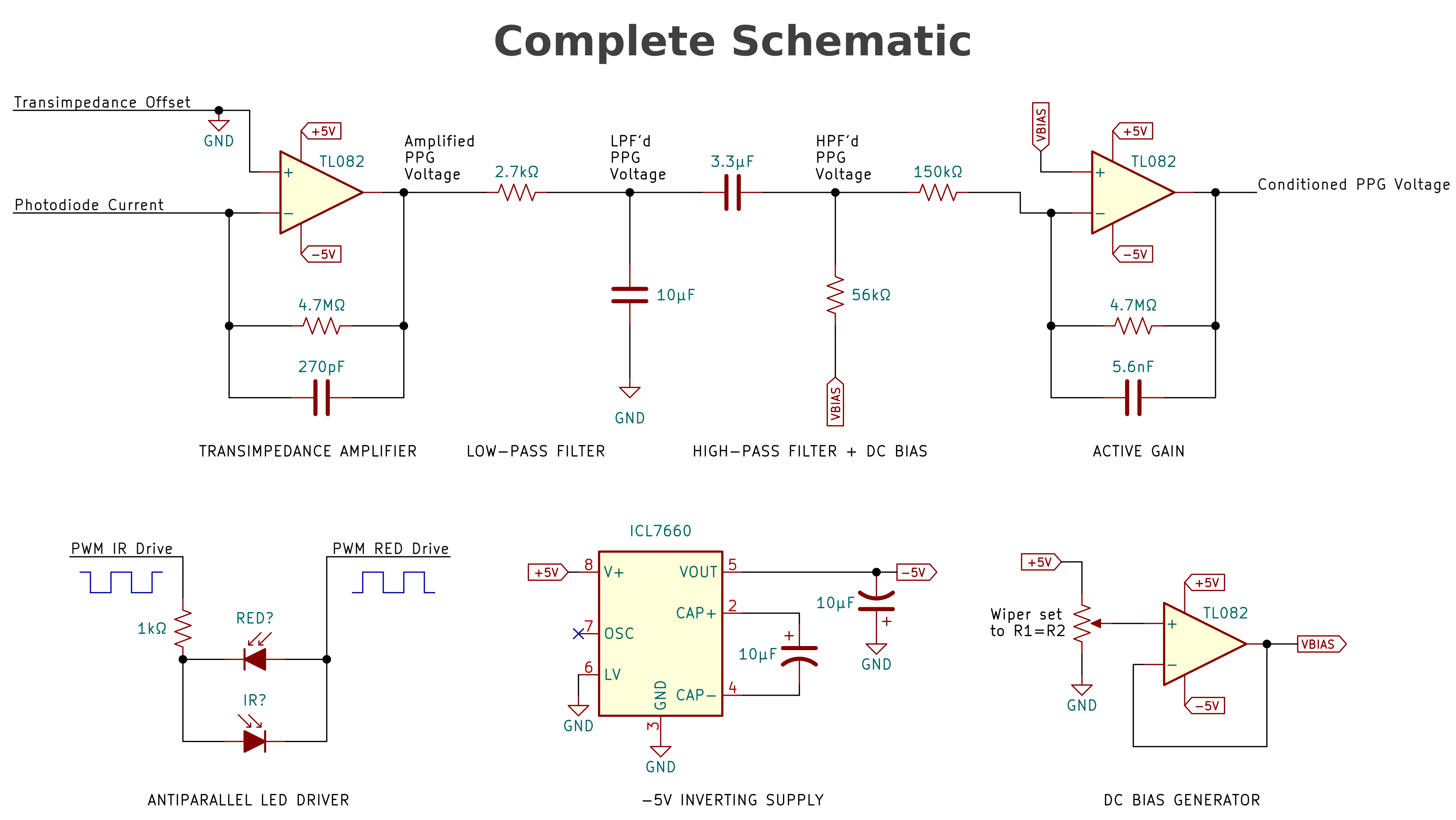
- Designed the hardware front-end to convert the photodiode output from a Nellcor probe into a usable photoplethysmograph (PPG) signal
- Created a two-way communication link between MATLAB and Arduino for LED control and data streaming
- Developed a real-time processing and visualization GUI to display signals, metrics, and system status
Final Product

Design Features
- Pulse-ox sensing using red/IR photodiodes front-end and synchronized LED driving.
- Full analog conditioning chain, delivering a clean PPG waveform.
- Bidirectional MATLAB-Arduino link for LED control, timing, and transmission of PPG data.
- Robust packet handling with checksums, timestamps, and error reporting for reliable data acquisition.
- Real-time digital signal processing pipeline for filtering and AC/DC amplitude extraction.
- Live SpO2 estimation using R-ratio calculation.
- Interactive MATLAB GUI for data visualization and system control.
System-Level Block Diagram

Click on the expandable tiles below for detailed technical information on each component of the system.
Hardware Front-End



Results
MCU Acquisition & Serial Protocol


Digital Signal Processing

- Fourth-order Butterworth low-pass filter (4 Hz cutoff) to suppress remaining quantization noise and high-frequency artifacts
- AC Component: Took maximum peak-to-trough distance, enforcing a minimum peak separation of ~0.4 s (~150 BPM)
- DC Component: Took median value of super low-pass filtered (0.5 Hz cutoff) signal
- Computed AC/DC ratio for both red and IR wavelengths to calculate
R value :
$$R = \frac{(\text{AC}/\text{DC})_{\text{Red}}}{(\text{AC}/\text{DC})_{\text{IR}}}$$
- From here, R was fit to an empirical calibration curve to estimate SpO2 using a linear approximation:
$$\text{SpO}_2\ (\%) = -25R + 110$$
Mixed-Signal Circuit Design
Embedded Arduino Firmware
Custom Serial Protocols
Digital Signal Processing
Real-Time Data Acquisition
GUI Design